
How did ocean warmth amplify East Asia’s 2023 heatwave, and how much?
Sea surface temperature is a crucial component of the Earth’s climate. In recent years, marine heatwaves, characterized by an abnormally high sea surface temperature persisting for an extended period, have become frequent globally, significantly impacting fisheries and marine ecosystems.
In the summer of 2023, the East Asian region, including Japan, experienced a record-breaking heatwave (Fig. 1, Left). The high temperatures, coupled with high humidity, particularly elevated the risk of human health problems, such as heatstroke. Coinciding with this record heatwave, surrounding seas also experienced unprecedented sea surface temperature anomalies (a marine heatwave) (Fig. 1, Right).
Previously, the main cause of widespread heatwaves was generally thought to be changes in large-scale wind patterns (circulation), such as jet streams. However, how and to what extent this oceanic anomaly (marine heatwave) influenced the land heatwave remains unclear.
To address this, our research utilized a set of numerical simulations to quantitatively evaluate “how much” the marine heatwave contributed to the 2023 summer land heatwave and reveal “what mechanism” was at play.

Marine heatwave amplified the extreme heat through a dual mechanism
Our simulations confirmed that while large-scale atmospheric circulation anomalies were the primary driver of the land heatwave, the surrounding marine heatwave further intensified the heatwave over land.
The mechanism by which the marine heatwave amplifies the heatwave involves two main processes (Fig. 2, Left):
- Reduced Cloud Cover, Stronger Sunlight (Enhanced Downward Shortwave Radiation): The abnormally warm sea surface suppresses the formation of clouds (low-level clouds), which would typically be abundant. The reduction in clouds allows solar radiation to reach the surface more strongly, leading to a temperature increase.
- Increased Humidity, Trapping Heat (Enhanced Downward Longwave Radiation): Increases in air and sea surface temperatures boost the amount of water vapor in the atmosphere. This water vapor strengthens the effect of absorbing heat radiated from the surface and returning it to the surface (trapping heat). This effect makes it harder for temperatures to drop, even at night, further amplifying the heatwave.
This dual mechanism of “stronger sunlight” and “heat trapping” significantly amplified the atmospheric heatwave.
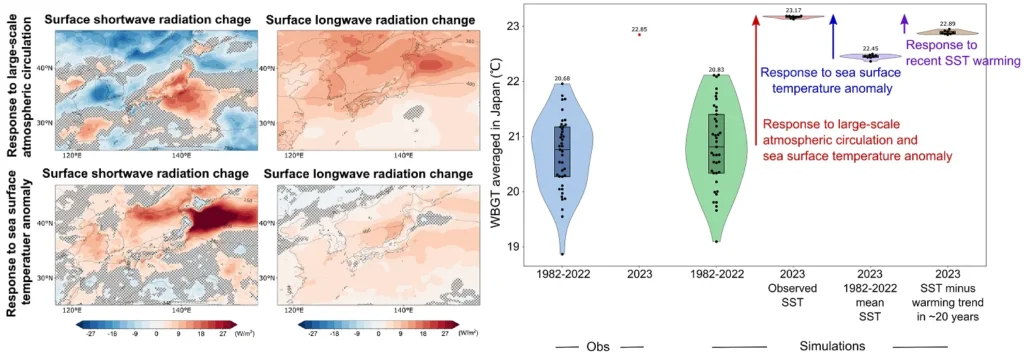
(Left) How radiation at the surface changed due to the marine heatwave. The response to the sea surface temperature anomaly (bottom-left of the four panels) shows an enhancement of solar radiation (downward shortwave radiation), particularly off the coast of Sanriku. The enhancement of heat trapping (downward longwave radiation) due to increased humidity was primarily caused by the large-scale atmospheric circulation change (top-right of the four panels), but the marine heatwave also contributed to this effect to some extent (bottom-right of the four panels).
(Right) The heatwave’s impact was assessed using the Wet-Bulb Globe Temperature (WBGT), an index for measuring human heat stress. WBGT is suitable for heatstroke risk assessment as it accounts for temperature, humidity, and solar radiation. About 30% of the increase in the 2023 summer WBGT compared to the average (red arrow) is explained by the response to the sea surface temperature anomaly (blue arrow). Furthermore, about 30% of the response to the sea surface temperature anomaly is explained by the recent ocean surface warming trend (purple arrow).
Perceived heat intensity and duration is amplified by up to 50%
We further estimated the Wet-Bulb Globe Temperature (WBGT), an index representing the degree of heat actually felt by humans, to evaluate the combined effect of temperature and humidity.
The analysis revealed that, in addition to the large-scale circulation changes causing the heatwave, the impact of the marine heatwave alone amplified the intensity and duration of the hot-wet condition in the East Asia region, particularly in Japan, by up to 20% to 50% (Fig. 2, Right). Moreover, the recent ocean surface warming trend accounted for a significant portion of this heatwave amplification effect due to the marine heatwave.
This research is the first in the world to quantitatively reveal the crucial role and mechanisms by which marine heatwaves, not just being solely oceanic phenomena, substantially amplify heatwaves over adjacent lands. This finding is essential for preparing for future extreme weather events and achieving more accurate seasonal forecasts. We plan to conduct further research on the meteorological conditions under which the impact of marine heatwaves on land is likely to manifest, and how the amplification of land heatwaves by concurrent marine heatwaves occurs in other regions.
For more details:
Okajima S., Y. Kosaka, T. Miyasaka, and R. Ito (2025): Unprecedented Marine Heatwave Significantly Exacerbated the Record-breaking 2023 East Asian Summer Heatwave, AGU Advances, 6, e2025AV001673, doi:10.1029/2025AV001673.
(Satoru Okajima@A01-3, ECHOES. November 2025)