
Marine heatwaves cause heavy rainfall and snowfall
From 2023 until early 2025, an extremely unusual situation occurred in the ocean to the east of Japan (Fig. 1). The Kuroshio Extension, which is a warm ocean current extending from the Kuroshio Current off the main island of Japan, meandered significantly northward. Consequently, warm subtropical seawater intruded northward, and record-breaking high sea surface temperature was observed. Such conditions of high sea surface temperature are recently referred to as ‘marine heatwaves’. The other column by Shusaku Sugimoto, entitled ‘The Kuroshio Extension has reached off Aomori Prefecture – What has happened off Sanriku since 2023?‘, provides a detailed explanation of this unusual oceanic situation.
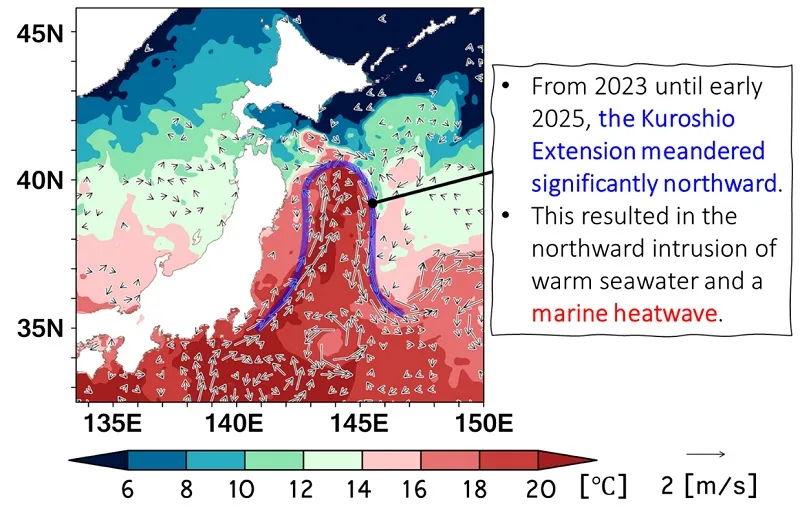
The meandering of the Kuroshio Extension significantly altered the marine environment, profoundly impacting marine life. Furthermore, this research project has revealed that its effects extend beyond the ocean, reaching the land as well.
In regions where marine heatwaves occur, the supply of moisture and heat from the ocean to the atmosphere increases. If you think of hot pot dishes or a steaming hot bath, then this phenomenon will make intuitive sense (Fig. 2). Water vapor is the source of rain and snow. Therefore, marine heatwaves may contribute to the occurrence of heavy rainfall and snowfall by increasing the amount of water vapor in the atmosphere.

Did the marine heatwaves associated with the meandering of the Kuroshio Extension actually contribute to heavy rainfall and snowfall in Japan? To answer this question, this study focused on two events: the record-breaking heavy rainfall in eastern Chiba Prefecture in September 2023 and the record-breaking heavy snowfall in Obihiro, Hokkaido, in February 2025 (Fig. 3). Both events had a significant impact on society. The heavy rainfall in Chiba resulted in human casualties, damage to residential areas, and transportation disruptions, while the heavy snowfall in Obihiro caused transportation disruptions and damage to buildings.
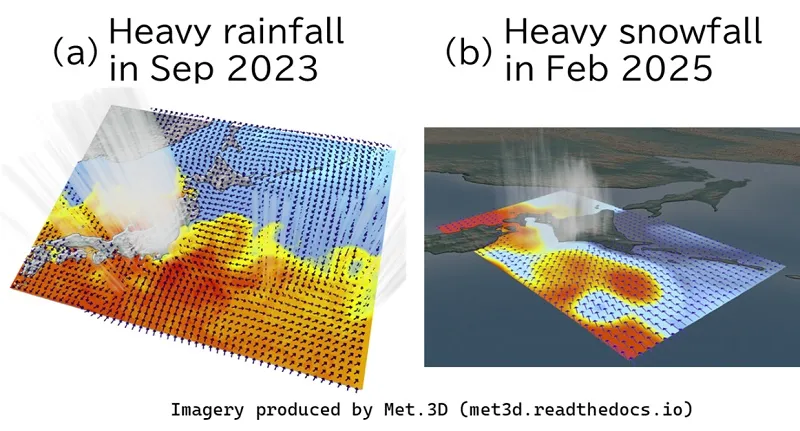
Using numerical simulations, we investigated the impact of the marine heatwaves on the two extreme weather events. The simulation reproduces meteorological phenomena within a computer (a virtual world) through numerical calculations based on physical laws. We conducted two simulations differing only in sea surface temperature conditions. One simulation used realistic sea surface temperature data representing the marine heatwaves, while the other used climatological normal data (i.e., conditions without the marine heatwaves). By comparing the results of these two simulations, we evaluated the impact of the marine heatwaves on the extreme weather events.
The simulations using realistic sea surface temperature data successfully reproduced the characteristics of observed heavy rainfall and snowfall. Conversely, the amounts of rain and snow decreased in the simulations using climatological normal data. The ratio of the increase in precipitation due to the marine heatwaves to the total amount of precipitation was approximately 70% for the heavy precipitation in Chiba and approximately 50% for the heavy snowfall in Obihiro. These results suggest that record-breaking heavy rainfall and snowfall would not have occurred without the marine heatwaves caused by the meandering of the Kuroshio Extension.
This study revealed that the marine heatwaves associated with the meandering of the Kuroshio Extension contributed to the occurrence of record-breaking heavy rainfall and snowfall. This finding demonstrates that extreme weather events and resulting natural disasters are strongly influenced by changes in the ocean around Japan. To contribute to building a safe and secure society with high habitability, we will advance further research aimed at deepening our understanding and improving the prediction of extreme weather phenomena influenced by changes in the marine environment.
For more details:
- Hirata, H., R. Kawamura, and M. Nonaka (2025): Effects of a marine heatwave associated with the Kuroshio Extension large meander on extreme precipitation in September 2023. Scientific Reports, 15, 5332, doi:10.1038/s41598-025-88294-9.
- Hirata, H., K. Tamura, T. Morioka, and T. Sato (2025): Mechanisms behind the record-breaking snowfall in Obihiro, Hokkaido, Japan, in February 2025: Roles of atmospheric environment and a marine heatwave. SOLA, 21C, 1–9, doi:10.2151/sola.21C-001.
(Hidetaka Hirata@A02-5. November 2025)