
Has global warming intensified heavy snowfall in Japan!?
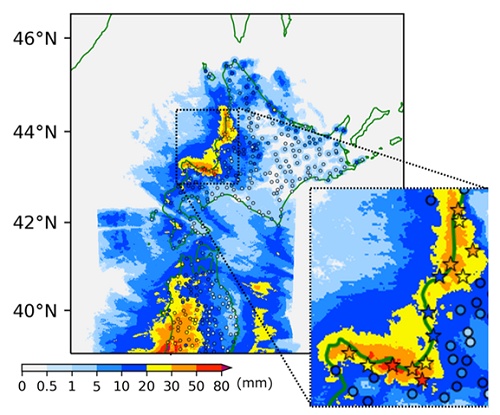
Due to rising air temperatures associated with global warming, significant changes in the cryosphere—such as decreases in snowpack and sea ice and glacial retreat—have been observed on a global scale. Japan, known as a snow-rich country, has also witnessed a long-term decline in snowpack, leading to challenges for the snow-related industry. However, in contrast to these trends, intense snowfall events continue to occur in recent years. For example, between December 17 and 18, 2021, a heavy snowstorm brought more than 50 cm of snow within 24 hours to cities like Sapporo and Otaru (Fig. 1). Could such snowfall be influenced by global warming?
To address this question, we applied machine learning techniques to a vast climate simulation database, selecting days with meteorological conditions similar to those observed during the event (Fig. 2), and conducted a detailed analysis. The results revealed that under such conditions, while near-surface air temperatures around northern Japan have risen due to ongoing global warming, mid-tropospheric temperatures have shown little change. In other words, the vertical temperature structure from the mid to lower troposphere has become more unstable as a result of warming (Fig. 3).
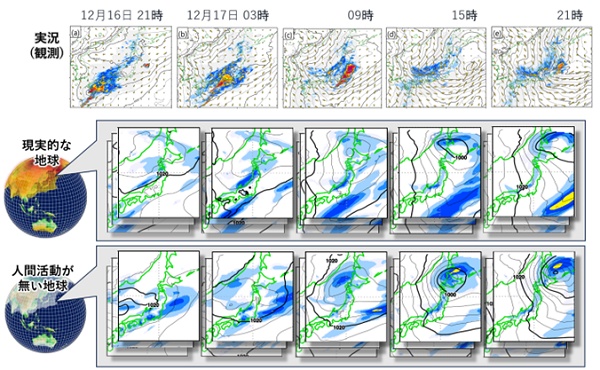

In addition to air temperature changes, we also examined other meteorological variables such as atmospheric moisture content. Changes in these variables attributable to human-induced warming were incorporated as boundary conditions into a high-resolution atmospheric model, enabling detailed simulations of snow clouds and snowfall. The findings showed that, in the 2021 case, snowfall amounts in Hokkaido—including Sapporo—increased by approximately 10 to 20 percent due to the influence of global warming (Fig. 4).

This analysis demonstrated two key findings: (1) global warming is already influencing heavy snowfall events, and (2) the extent of this influence varies depending on the meteorological conditions and regions involved. The methodology developed in this study offers a powerful tool for quantitatively assessing the impact of global warming on extreme weather events—such as heavy snow, torrential rain, and heatwaves—that are becoming increasingly severe worldwide. It not only enhances our understanding of the mechanisms behind extreme weather, but also contributes to the advancement of climate change mitigation efforts.
For more details:
Tamura, K. and T. Sato, 2024: Evaluating how historical climate change affected a heavy snowfall event in northern Japan in mid-December 2021 using two pseudo global warming methods. Journal of Geophysical Research – Atmosphere, 124, e2024JD041553, doi:10.1029/2024JD041553.
(Tomonori Sato@A03-8. September 2025)